
Kandiyohi Parole and Probation Compared
Minnesota uses several terms for control after release. Probation is a court sentence served in the community under stated terms. It may follow a short jail stay, or the judge may order it without a prison term. Supervised release is the community part of a Minnesota prison sentence. For most fixed felony sentences tied to offenses on or after August 1, 1993, Minnesota Statutes section 244.101 divides the sentence into a prison part and a supervised-release part. Parole still applies to life sentences, older indeterminate sentences, and other limited cases handled by the Minnesota Supervised Release Board.
The source depends on the sentence. Kandiyohi County probation is checked through the court case and Kandiyohi County Community Corrections. State supervised release or parole is checked through the Minnesota Department of Corrections, or MNDOC. A person can be out of prison but still under MNDOC jurisdiction. Final discharge is different. It means the sentence or supervision has legally ended.
| Status | Who orders it | Best public check |
|---|---|---|
| Probation | Kandiyohi County District Court | MCRO case, sentencing order, and Community Corrections |
| Supervised release | State law and MNDOC sentence administration | MNDOC Locator status, unit, agent, and expiration date |
| Parole | Supervised Release Board for its limited population | MNDOC Locator, Board records, and Central Records |
| Final discharge | Court or MNDOC, based on the sentence | Discharge order, expiration field, or official custody chronology |
- Supervised release
- The community portion of a state prison sentence, with conditions, before sentence expiration.
- Parole
- Conditional prison release used for Minnesota's limited Board-governed cases.
- Probation
- A court-ordered community sentence monitored by a corrections office.
- Absconder
- A supervised person alleged to have stopped reporting or left supervision without permission.
- Discharge
- The legal end of the sentence or supervision, not merely release from confinement.
Verify Kandiyohi Post-Release Supervision
Begin with the last sentence, not the old jail row. The Minnesota Court Records Online application, called MCRO, can connect the person to a Kandiyohi criminal case. Its Register of Actions may show the judgment, probation order, later violation filings, and discharge or closure events. The MNDOC Locator serves a different role. It covers adults still under MNDOC jurisdiction, including people released from prison who remain under state supervision. It is not a permanent list of everyone once held by the state.
Use exact identifiers whenever possible. Names can collide. The Kandiyohi jail row may provide a court charge or booking identifier, while MNDOC uses a six-digit offender ID. Compare birth date, court file, offense, and current status before treating a result as the right person.
- Open MCRO and find the Kandiyohi County case. Confirm the party and court file before reading the sentence.
- Read the judgment and Register of Actions. Look for probation terms, violation filings, revocation, and any discharge entry.
- Search the MNDOC Locator by full name or complete six-digit offender ID. Review the current status and its effective date.
- If the record says Under Supervision, Intensive Supervised Release, or parole, note the responsible unit, agent, and expiration date.
- Contact Kandiyohi County Community Corrections for local probation routing. Use the agent named on a current official record for state supervision.
- If no public result appears, ask the sentencing court or MNDOC Central Records for the discharge or custody-status record.
A full release search may require the county release record as well. The Kandiyohi County released-inmate search path explains how to distinguish a community release from a transfer before checking supervision.
Kandiyohi Supervised Release Status
An MNDOC result can verify prison release while the sentence remains active. A released record may show Current Status, the date that status took effect, the responsible DOC unit, an agent or caseworker, the highest-ranked offense, a court file, and the sentence expiration date. A facility name instead points to confinement. New state commitments can take several business days to appear, so a gap after transfer from Kandiyohi County Jail should be treated as unconfirmed movement, not community release.
The official MNDOC example of community supervision shows how a prison-release record differs from a prison record.
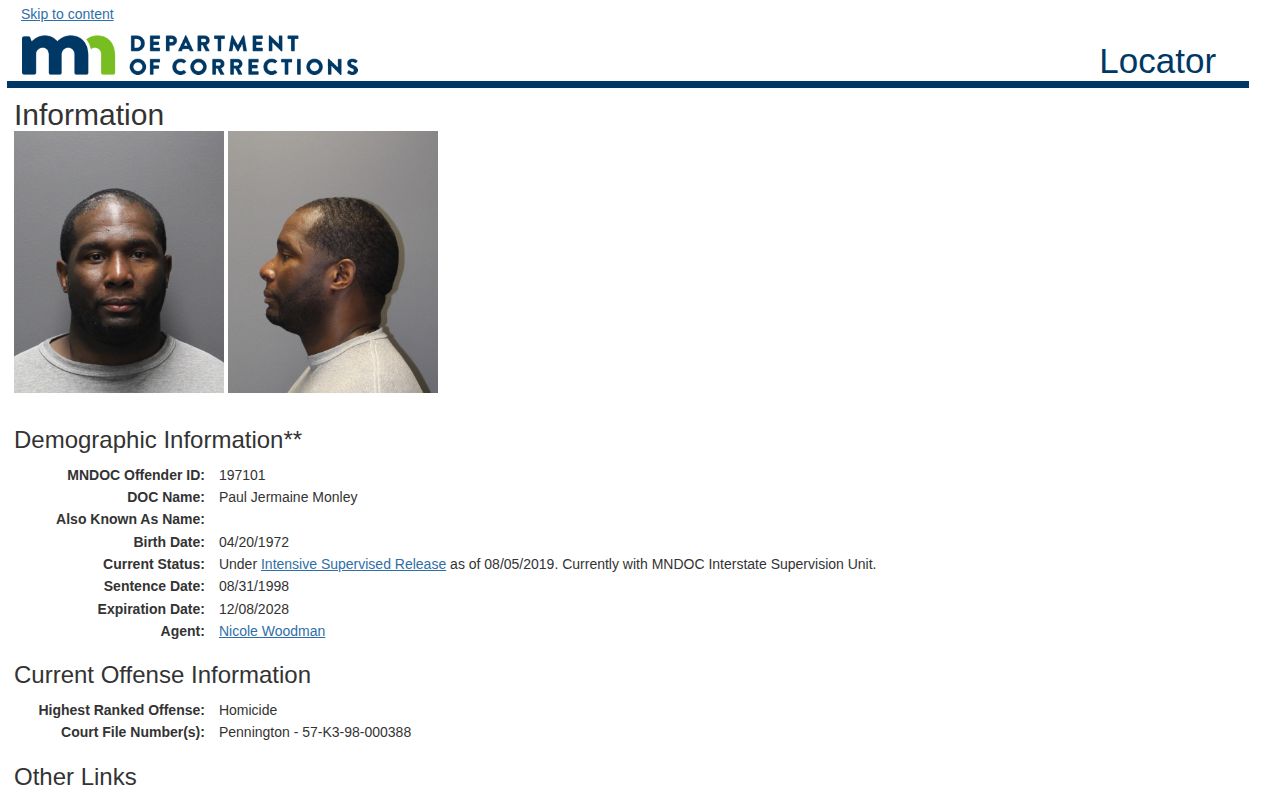
The status, responsible unit, agent, and expiration fields are the useful parts of this view. An expiration date is not always the prison release date. The confinement date comes first, while supervision may continue until expiration or formal discharge. For historical detail, MNDOC Central Records can supply a releasable custody chronology and the actual release, confinement-release, and termination fields maintained by the department.
Note: A person who is no longer under MNDOC jurisdiction may disappear from the live Locator even though the past supervision record still exists.
Kandiyohi Probation Office Contact
Probation imposed by Kandiyohi County District Court is routed through the local corrections system. Minnesota's S3 statewide supervision system is used by authorized justice agencies, but it is not a public person-search portal. The public route is the court record plus the local office. Since officer assignments change, the office or a current case record is more reliable than an old name.
Kandiyohi County Community Corrections2200 23rd Street NE, Suite 2060
Willmar, MN 56201
Phone: 320-231-6222 ext. 2233
MNDOC Community Services Directory entry
This office can route a probation inquiry and help identify the responsible local unit. It should not be asked to infer custody from an old jail listing. If a court order and the office give different impressions, request the filed order and confirm the current assignment with Community Corrections.
Kandiyohi Supervision Conditions and Violations
Conditions are the rules attached to release or probation. They can include reporting, travel limits, treatment, testing, contact limits, or other terms stated in the order or MNDOC Conditions of Release form. The exact terms are person-specific. A general description cannot establish whether a violation occurred.
A violation filing, warrant, or fugitive entry marks an enforcement step. It is not proof that the person is now jailed. MNDOC maintains an Active DOC Fugitives search for people wanted by state corrections. Local probation issues may instead appear in the Kandiyohi court docket or county warrant data. Revocation is the formal process that can return a supervised person to confinement. A new custodian must still be confirmed through its own roster or record.
The safest sequence is compact: read the supervision source, identify the alleged event, open the court or revocation record, and then check the current custodian. Minnesota VINE may provide a county-jail custody alert, but it does not monitor the terms of probation or state prison supervision.
Kandiyohi Probation Warrant Check
Kandiyohi County has an unusual public source for a post-release check. Its official active-warrant list is timestamped and includes warrant number, name, birth date, warrant date, bail information, offense level, and a short description. Some descriptions identify probation or conditional-release violations. That makes the list useful when a court case suggests a new enforcement event.
The Kandiyohi County active-warrant list shows the fields available in the local check.
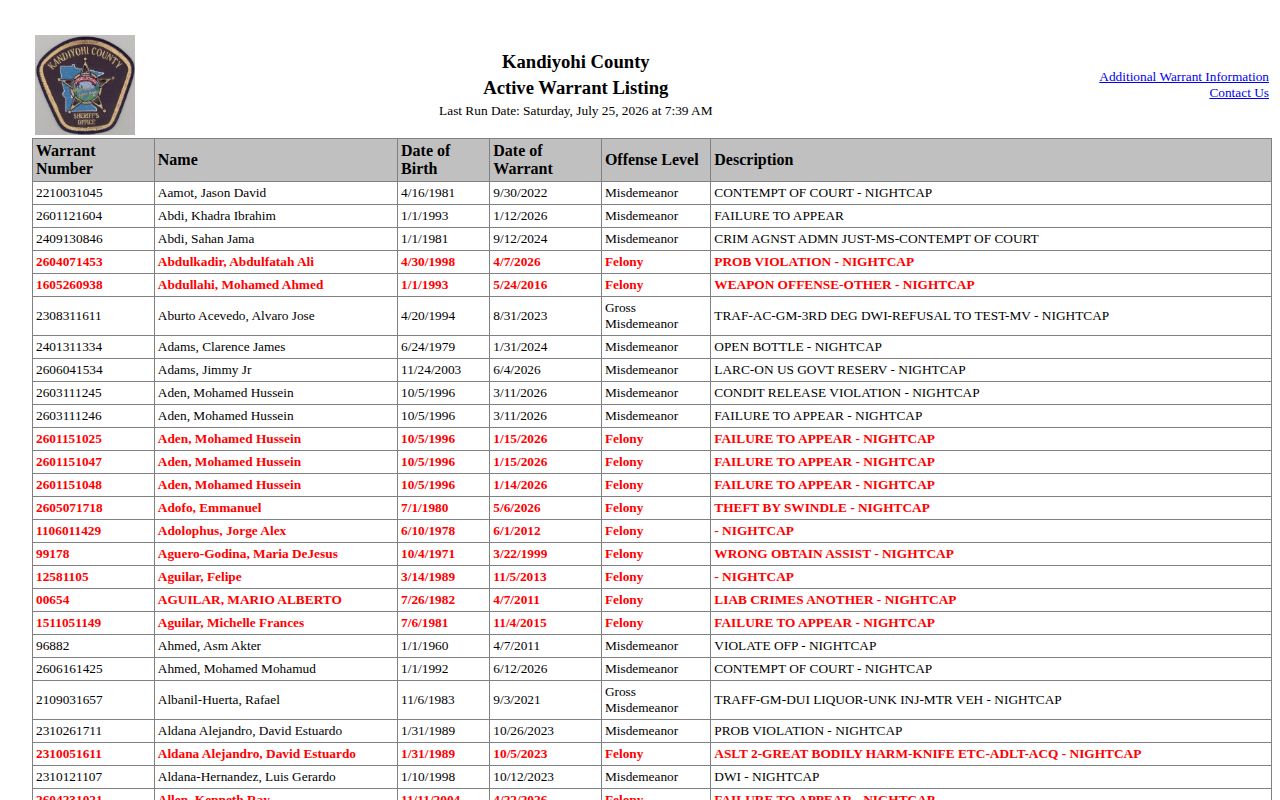
The timestamp and warrant description help place the entry in context. Still, the list is not a complete roster of people on parole or probation. Absence does not prove good standing or final discharge. Presence does not prove arrest. Confirm the warrant in the court case, then use the correct jail, MNDOC, federal, or immigration system to check custody.
Correct Kandiyohi Release Records
Release can create an immediate need for sound identity records. Kandiyohi County's 2020 jail report says people in custody could obtain information about applying for a birth certificate, Social Security card, and valid driver's license. The report is historical and does not prove that the same program or schedule is offered now. It does show that identity documents were part of local release preparation.
A separate county process addresses data errors. The Kandiyohi Data Practices Manual permits a data subject to challenge the accuracy or completeness of county data in writing. The county then has 30 days to correct the challenged data and try to notify prior recipients, or to state why it believes the data are correct. If the dispute remains, later disclosure must include the person's statement of disagreement.
This route matters when a county release time, transfer destination, or disposition is recorded incorrectly. It does not replace an appeal of the sentence or a challenge to an MNDOC record. Send a state-record issue to MNDOC through its own data-practices process.
Kandiyohi Supervision and Final Discharge
Release from confinement, reduced reporting, and final discharge are three different events. Minnesota's earned-compliance framework can place an eligible person in supervision abatement status. Abatement ends routine active correctional supervision, but it does not move the legal sentence expiration date. Someone may therefore have left prison and stopped routine reporting without being finally discharged.
For MNDOC supervision, compare the Locator's status and expiration date with a Central Records chronology. Ask for the actual release date, confinement release date, release-status type, termination date, and any releasable Conditions of Release record. For Kandiyohi probation, read the court's discharge or closure entry and confirm it with Community Corrections. A missing live result alone is weak proof because MNDOC visibility can end when jurisdiction ends.
The Minnesota Supervised Release Board has a narrower role than its name may suggest. Under section 244.049, it handles specified life, old indeterminate, and qualifying early-release cases. Most modern fixed sentences do not depend on a Board vote. Even a favorable Board action may set authority for release without proving the person physically left confinement that day. The MNDOC status and actual release record complete the check.
Note: Treat the final discharge record as the endpoint; neither a jail exit nor a drop in routine reporting proves the sentence has ended.